


Introduction
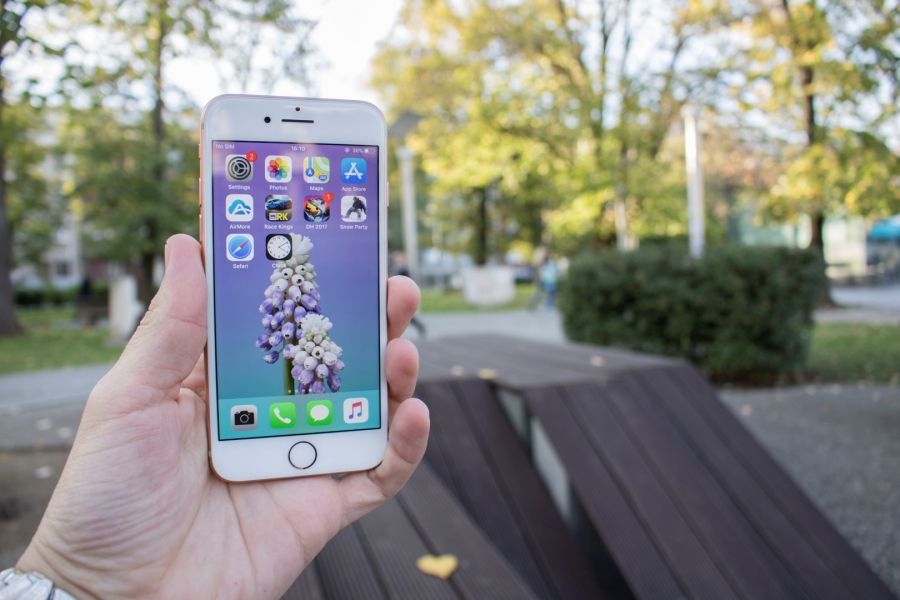
The new Apple iPhone is here! As we got used to, from September to September, we get a new mobile machine from Apple this time as well. Up until the 5S, each year marked the launch of only one new device. 5S, however, launched side by side with the 5C, and since the iPhone 6 we can see the Plus versions also, which were generally bigger and better. This year, we saw the launch of three new devices! This way we got the standard iPhone 8 with the diagonal of 4.7”, which we are testing now, a 5.5” iPhone 8 Plus, and the iPhone X – the Apple’s response to the trend of shrinking the bezels and infinite displays. iPhones 8 and 8 Plus are available on the market since September, while the iPhone X sales began on November 3. Although design-wise, the iPhone 8 resembles last year’s model, under the hood it is packed with innovations which make a distinct difference between these two. Since the iPhone 5 and until the iPhone 7 we had a fully aluminum chassis, but this time we go back to the roots – to the full glass design we could see in the iPhone 4S for the last time, and this time Apple claims that the glass on the iPhone 8 is the strongest glass ever implemented in a smartphone.

Glass on the back enabled the implementation of wireless charging, although we don’t consider it the greatest of advantages since certain Android devices had this option way back in 2013. The real news is the new camera, as well as the Apple A11 Bionic chipset which has brutal performance. Inside the factory box of the iPhone 8 we can find: a charging adapter (not a fast charger, although the iPhone finally support it now), a USB cable, a SIM tray tool, user manuals and a Lightning to 3.5mm adapter. We’re testing the Gold color option, but also available are: Space Gray and Silver. What does the new apple bring us? We can’t wait to see!


Video review
Unboxing
Display
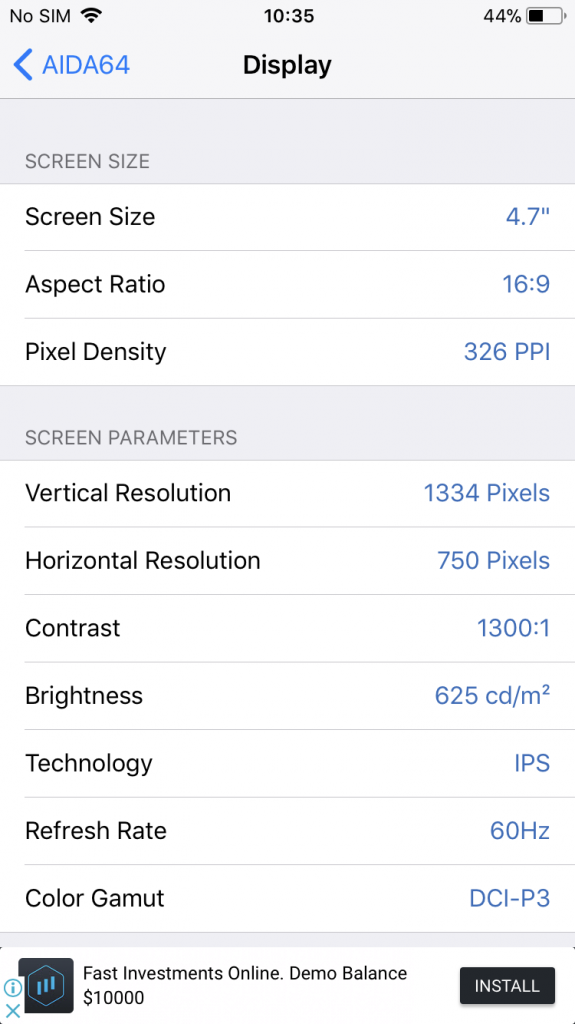
When choosing the display for the new iPhone, Apple has stuck to their own thing retaining compactness and authenticity, and reached for a 4.7” diagonal display. Although the diagonal has remained unchanged since the iPhone 6, the views on the display have improved. We still have the same IPS LCD panel with the LED backlight. The resolution is unusual – 750 x 1334, and combined with the diagonal it results in well-known Retina quality – that is 326 PPI. The aspect ratio is 16:9, and the screen-to-body ratio is only 65.4%, which isn’t really on par with the competitors who have “Infinity” and “FullView” displays which go way over the 80% limit, however, Apple have another runner for that race, the iPhone X.

The panel of the iPhone 8 shows up to 16 million colors, and it really does the best job so far – colors are very vivid, realistic, and they stay that way even when viewing angles are changed. What Apple point out is the Wide Color Gamut which is basically the DCI-P3 algorithm used in American film industry. Add to this the True-tone mode, and the reproduction on this screen becomes phenomenal. Video reproduction on the iPhone 8 is outstanding. Although it doesn’t follow the competitors regarding the diagonal, the quality of reproductions improves things a lot. It, however, cannot reach the same level of contrast and shades of colors as HDR displays, as it is, in fact, not an HDR display, but Apple have said on their official website that the iPhones 8 and iPhone 8 Plus are fully HDR and Dolby Vision compatible. Anyway, the experience is excellent, and a wide range of supported video material formats will make everyone happy. Something that we’ve had a chance to see in the iPhone 6S for the first time and that has remained in the iPhone 8 is the 3D touch. It is a system that brings multi-touch capabilities to a whole new level. The thing is that the screen can actually register the “strength” of the press, and in regards to it offers multiple options. Combined with the Taptic Engine, the 3D touch offers better sense of interaction with the device itself, producing a slight vibration when the screen is pressed harder.

We are used to having oleophobic coating over the screen of iPhones, which means that we have a thin coat of a material sprayed over the display which brings the fingerprints and any dirt down to the bare minimum. In this device, we don’t have Corning Gorilla Glass protection, because Apple have opted for another protection method – the glass on the front panel is heated up in order to increase the strength. Maximum and minimum brightness levels are amazing, while the visibility on the sunlight is on par with the iPhone 7, which was a significant improvement compared to the iPhone 6S. Next to all this, it is worth to mention the “Night Shift” mode, which reduces the stress on the eyes during use by emitting yellowing shades. This is Apple’s response to Samsung’s “Blue Light Filter”.



Hardware and OS

Another thing that is new is the tri-core GPU which offers brutal performances, better even than the very powerful Adreno 540. The GPU is completely made in house by Apple. Combining this GPU with the low resolution display results in remarkable 3D performances and perfectly fluid user experience. While certain devices of Android world boast with 6GB of RAM, or even 8GB, Apple chose to stay at 2GB of RAM. Although this seems to be little, multitasking performances aren’t endangered in any way, and they are comparable to, for example, the Galaxy Note8’s, which has 3 times more RAM memory. This is optimization on its best level! Paired with 2GB or RAM, the iPhone 8 comes with either 64GB or 256GB of internal storage, which is not expandable via a microSD card.

The fingerprint scanner is this time as well located on the front side of the device implemented into the Home button, and it works great since Apple have really perfected this way of protection. If we are to speak of benchmark tests, Apple again sets new records, while the competitors struggle to reach last year’s levels. The iPhone 8 scored 208 117 points on the AnTuTu benchmark, which is an amazing result around 20% better compared to the best Android device.

Overheating is not something that is familiar with the iPhone 8. Screen transitions, application execution and web surfing all work perfectly. What especially sets the iPhone apart from its Android counterparts are its gaming performances – if you like gaming you’ll notice far shorter loading times. The device has outstanding stereo speakers implemented, which offer amazing sound reproduction. As all modern premium devices, the iPhone 8 is also water and dust resistant. It is IP67 certified which means that your iPhone will endure submerging to 1m depth for 30 minutes.
Same keynote that presented the iPhone also presented the new iOS it will run on. It is the iOS 11 which brings a lot of new things.
As we were testing the device, several system updates came live, so we installed them all finishing at version 11.1


Camera
Another area which is greatly improved is the main camera. Although this is the same 12MP sensor, it now provides much better results. OIS is still here, as is the same aperture and the angle width – 28mm. For low light shooting conditions we have the quad-LED two tone flash. Photos are, in one word, perfect! Contrast is very good, and the sharpness is excellent combined with 12MP resolution. Color reproduction is also great, with no oversaturation which would lead to inaccurate views. Noise levels are very low, and we have really no issues with it. Night time photos is another very positive characteristic of the iPhone 8’s camera, thanks to the aperture and optical stabilization. The new iPhone also has the “High Efficiency” shooting mode, which shoots photos in HEIF format. It is the “High Efficiency Image Format” which uses higher compression levels but with no loss of quality. This way memory is saved up to 50%. Apple really scored with this format, it really does reach excellent results.

Another area where Apple shine is video recording, in a way that iPhones 8 / iPhone 8 Plus / iPhone X all have the capability to record high quality 4K videos at 60fps. Videos look remarkable, and they are very fluid with stable 60fps framerate. All this is enabled through the high efficiency mode which captures videos in HEVC (High Efficiency Video Coding H.265) format which really isn’t that wide-spread. Next to 4K@60fps videos there is also one of the best “slow motion” videos out there – 1080p FullHD videos at 240fps.

Next to these two, also available are:
- 720p@30fps
- 1080p@30fps
- 1080p@60fps
- 1080p@240fps
- 2160p@24fps
- 2160p@30fps
- 2160p@60fps
Although videos and photos are recorded in relatively unsupported formats, you won’t have any problems viewing them on other devices, because Apple have thought of this as well. When sending HEVC videos to other devices, video formats will automatically be converted to H.264 format. Same thing goes for photos as well – from HEIF to .jpeg. Amazing, thumbs up, Apple!
Speaking of the camera interface itself, nothing much has changed. A typical iPhone environment we’d say. Let’s start from the top: upper left corner contains the flash mode, next to it to the right is the “switch” for Live Photo mode, then the self-timer and finally on the far right there is a button that lets you choose the effects:
- Original
- Vivid
- Vivid Warm
- Vivid Cool
- Dramatic
- Dramatic Warm
- Dramatic Cool
- Mono
In the lower left corner there is the shortcut to the gallery, and on the opposite side there is a switch to the front facing camera. Supported modes are:
- Time-Lapse
- Slow-Motion (1080p@240fps)
- Video mode
- Photo mode
- Square mode
- Panorama mode

The only downside to this menu is that if you choose to change any of the camera parameters, you’ll have to jump into the Settings menu, where the camera options are hidden. It is, however, what it is – that is simply the way iOS works!
FullHD 1080p videos at 60fps also work excellently, and they are nicely stabilized. Videos taken in 24fps are there only to add to the movie effect. The only downside to taking videos is the mono sound. When it comes to the front facing camera, we have the same sensor as on the iPhone 7. It is the 7MP sensor with the aperture of f/2.2. It can detect faces in order to sharpen the image, it supports the HDR mode and it can capture panorama photos. Pictures taken with the front facing camera are very good with a solid level of details, however, we did see better results in some Android devices. A flaw is definitely the lack of autofocus system. The front facing camera captures videos in 1080p FullHD resolution at 30fps, and it also enables slow-motion video capturing in 720p HD resolution at 240fps. Flash is executed through software means.


Connectivity
Supported wireless connections are:
- WiFi 802.11 a/b/g/n/ac
- Bluetooth v5.0
- NFC (used only for ApplePay on supported markets)
- A-GPS
Supported frequencies are:
- 2G GSM: 850 / 900 / 1800 / 1900 MHz
- 3G UMTS: 850 / 900 / 1700 / 1900 / 2100 MHz
- 4G LTE: 700 / 800 / 850 / 900 / 1700 / 1900 / 2100 MHz
- 4G TDD-LTE: 1700 / 1900 / 2000 / 2100 / 2300 / 2500 / 2600 MHz


Battery
Battery in the iPhone 8 has the capacity of 1821 mAh. Although, on paper, it seems small, thanks to the perfectly optimized software and very efficient chipset regarding battery consumption, it can offer up to 40 hours of music reproduction or around 14 hours of 3G talking time on a single charge. As usual, the battery is non-removable and it is a Lithium-Ion battery. The device support fast charging, but despite it being supported, the fast charger is not shipped with the device inside the factory box. As we have previously mentioned, wireless charging is also enabled through the glass on the back, but – you guessed it – you’ll have to buy the wireless charger separately.

Final words
Apple have once again presented the iPhone as a serious player in the smartphone game, and they have proved that they can easily deal with the competitors, and even be ahead of them at times. The iPhone 8 really is an excellent device! Premium build quality, great cameras and unbelievably fast A11 chipset are only some of the bright spots of this device. We have somehow forgotten the lack of 3.5mm headphone port, but mono sound in videos is something we cannot disregard. As a whole, regarding technology, the design of the device itself and user experience – undoubtedly the iPhone 8 is a premium device in all aspects, but the iPhone X changes everything – most users decided to wait for the device which represents the new way for Apple regarding smartphones. However, if you like the iPhone 8 from what you’ve read, it is definitely a good choice, especially taking into account the price of the iPhone X.
Do you like the iPhone 8? We’d like to see your opinion in the comment section below. If you have any ideas or you would like to see a specific device being reviewed soon, feel free to let us know here or on our Facebook page. If you liked this review, subscribe to our Youtube channel, like us on Facebook, and sit back and relax while we make more of the same for you.


