


Introduction
OnePlus is a Chinese brand established in December 2013, and their specialty are top class smartphones. After several successful and exclusive premium class devices from OnePlus, the brand gained great popularity. Calling their devices “Flagship killers” and with the slogan “Never Settle”, OnePlus had highest performances in mind for accessible prices. Their first device that entered the world of “high-end” devices was OnePlus One in 2014, followed by the OnePlus Two in 2015. The newest representative of the OnePlus – the OnePlus 3, got huge popularity. This device is known as one of the first Android smartphones packing 6GB of RAM and a Qualcomm Snapdragon 820 SoC. It directly competed with devices from Samsung, Sony and LG. OnePlus 3 became available in June 2016, and it can be obtained through the OnePlus web-shop. The device we have today for the review in OnePlus 3T in Midnight Black color with 128GB of internal storage (DualSIM) and it represents a limited edition “3T” which is a refreshed version of the OnePlus 3.
Compared to the OnePlus 3, it brings:
- new chipset: Qualcomm Snapdragon 821 (higher clock speeds of both the CPU and GPU)
- front facing camera with 16MP resolution (“3” had an 8MP front facing camera)
- bigger battery with the capacity of 3400 mAh
- three colors: Gunmetal, Soft Gold and Midnight Black (limited)
Can the 3T complete its task on the highest level, and once again shake the throne of much more expensive competitors? Let’s see what the OnePlus 3T brings us.
Unboxing
Display
Making the OnePlus 3T, OnePlus has once again reached for the tried and tested panel – the Optic AMOLED. The screen has FullHD resolution with a diagonal of 5.5”, while other manufacturers mostly opted for QHD (2560 x 1440 pixels) for their “high-end” models. The number of PPI is 401, a number which is ideal because it offers great sharpness while reducing the battery consumption due to the lower resolution. Another advantage of the smaller resolution panel compared to the competitors is that when this resolution is combined with good a CPU and GPU, which in this case are Qualcomm Snapdragon 821 SoC and Adreno 530 GPU, brutal performance is guaranteed in every segment. The panel shows up to 16 million colors and it offers very vivid colors with deep blacks and excellent contrast, which are the main advantages of AMOLED displays. The screen takes up 73.1% of the front panel of the device and with very thin bezels it is extremely pleasant for video reproduction and photo viewing. Visibility on sunlight is on par with the competitors, but the crown regarding visibility on sunlight still remains at Samsung. The only flaw of the display in OnePlus 3T is that the resolution is not perfect for the more and more common virtual reality (VR).
Hardware and OS
The first version of the OnePlus 3 was equipped with the best available chipset at the time. OnePlus 3T brings the refreshed and faster version – Qualcomm Snapdragon 821. It is a quad core chipset, two of which are clocked at 2.35GHz, and other two clocked at 2.16GHz. Adreno 530 GPU is in charge of the graphics, a GPU which is known from the Snapdragon 820, but this time clocked at higher 652 MHz. This time as well there are 6GB (LPDDR4) RAM, which is this time clocked at 1866 MHz (1333 MHz in the OnePlus 3). UFS 2.0 NAND chip with the capacity of 128GB is in charge of internal storage. As we have already said, with the 1920 x 1080p display and the said chipset, OnePlus 3T dominates in all benchmark tests, and it places itself at the very top to Android devices regarding performances (AnTuTu, 3D Mark, 3D games…) This device comes with preinstalled Oxygen OS 3.5.1 (based on Marshmallow 6.0). Until the end of our review, an update to Android v7.0 Nougat already came live.
Camera
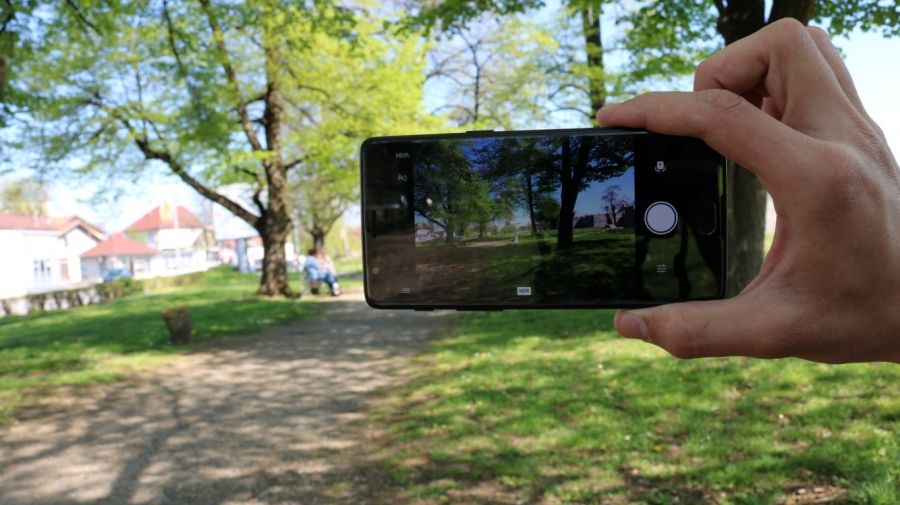
For the refreshed version of the OnePlus 3, OnePlus has prepared improvements for the cameras as well. The rear facing camera sensor still had 16MP resolution. As in its predecessor, it’s still the Sony IMX298 sensor. Although this sensor is on the market for quite a long time now, it is a tried and tested, and still very capable sensor. Optical image stabilization (OIS) is also here, as well as an LED flash for low light environment shooting. Camera interface is very similar to those of Nexus lineup, and it offers plenty of options swiping from left to right (Time-lapse, Slow motion, Video recording, Manual mode and Panorama mode) The main camera captures videos in 4K resolution at 30fps (1080p at 60fps, 720p at 120fps), while the manual mode allows the manual setting of each parameter (shutter speed, ISO, white balance and focus). Results are excellent. Sharp, edge to edge pictures with low levels of noise places the 3T into the very top class regarding cameras in Android devices. Video also offers excellent results with constant FPS and very well-set continuous auto-focus. The main news in the 3T compared to the 3 is the improved front facing camera which now takes pictures in 16MP resolution (OnePlus 3 camera had 8MP). The front facing camera takes excellent photos, focal length is well adjusted and color reproduction is great. The only downside could, perhaps, be the shutter speed. This camera captures video in 1080p at 30fps.
Connectivity
List of connections the OnePlus 3T is equipped with contains everything that one could expect from a modern flagship. This is a DualSIM device and it operates with nanoSIM cards. Next to the standard 2G and 3G networks, the 4G and VoLTE networks are also supported. Reversible USB Type-C cable is used for charging and data transfer, and it is shipped in the factory box.
The list of wireless connections contains:
- WiFi 802.11 a/b/g/n/ac
- NFC
- DLNA
- BlueTooth v4.2 (with A2DP support)
- A-GPS
Battery
Compared to the OnePlus 3, the OnePlus 3T brings increased battery capacity from 3000 mAh to 3400 mAh. The battery capacity in on par with other premium manufacturers’ devices and it allows for around 290 stand-by hours with 2 SIM cards inserted. Previous devices showed excellent talk time results, and this tradition is continued in the 3T, which will allow up to 30 hours of talk time with one full charge. When it comes to fast charging, OnePlus call their system – DashCharge, and it offers 60% charge in 30 minutes. An advantage of the OnePlus charging system is that all components which are needed for the quick charging are contained in the adapter itself, which eliminates the overheating of the device when using the system.
Final words
OnePlus have already proven themselves to be viable in the field of premium manufacturers with their previous devices. This time also, there are no mistakes. For its price, the OnePlus 3T offers quite a lot. From the amazing chipset and almost stock Android environment to Optic AMOLED display, we really couldn’t find a flaw. Oxygen OS fulfilled all our expectations, and the level of user interface adaptation is top notch. All in all, the OnePlus 3T represents one well-rounded device with strong support (our device ran on v7.0, immediately after our tests OTA update to v7.1.1 was released) and on-time updates which will, we are sure, find its way to many satisfied customers.
Do you like the OnePlus 3T? We’d like to see your opinion in the comment section below. If you have any ideas or you would like to see a specific device being reviewed soon, feel free to let us know here or on our Facebook page. If you liked this review, subscribe to our Youtube channel, like us on Facebook, and sit back and relax while we make more of the same for you.
OnePlus 3T Full Specifications